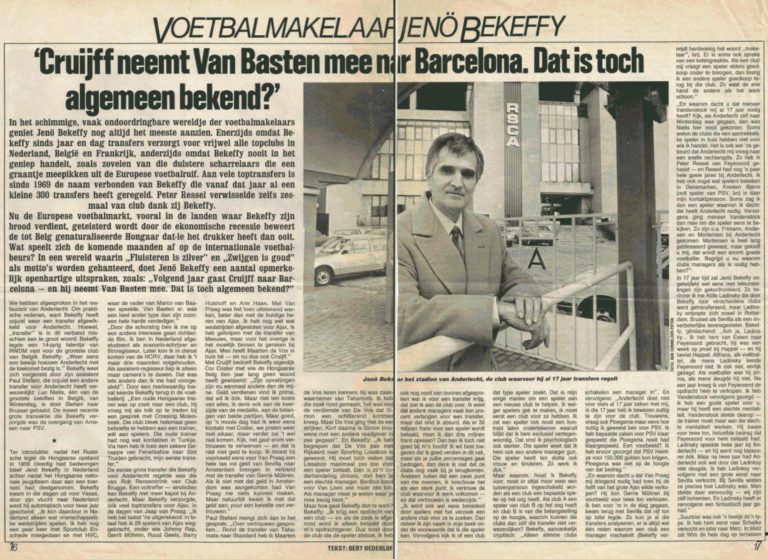
Date: 1986 Subject: Jenő Békeffy, first european football manager with more than 300 big transfers.
Jeno Bekeffy (48) is regarded in this region as the quintessential football agent. The former Hungarian player is based in Waterloo but spends most of his time on the road, scouting players and trying to persuade top European clubs to invest in promising but affordable talent.
Bekeffy holds an official UEFA license for his work—one he earned back in the days when he played alongside Abe Lenstra for Sportclub Enschede. The UEFA has issued only seventeen such licenses, of which just two are held in the Netherlands. Among the few with this credential are Ger Lagendijk, who represents several national stars, and Bob Maaskant, currently the manager of NAC. Both are officially authorized to operate as intermediaries in the football world.
Alongside these professionals, however, is a crowd of opportunists who stir up wild transfer rumors—claims like Vanenburg moving to Juventus or Gullit heading to FC Köln—mainly to draw attention to themselves.
Bekeffy recently clashed with Frans Ensink, another agent focused primarily on foreign players. Many within the industry believe these deals often rely more on personal connections and backroom dealings than on merit or professionalism.
In any case, after Hungary’s 0–1 loss to the Netherlands, there was little for Bekeffy to celebrate—on or off the pitch.
Jeno Bekeffy launches a rocket of his own.
“Next summer, Johan Cruyff will become coach of Barcelona, and he believes Van Basten will go with him,” says Bekeffy. “I thought that was already well known in the Netherlands.”
A bold claim or reality?
It’s a fact that Cruyff and Ajax have reached an agreement, and the KNVB (Dutch Football Association) decided to suspend him until the summer of 1987. But history shows that new coaches in Barcelona often bring their own people.
Michels once brought Cruyff to Camp Nou, Menotti brought Maradona and all of Argentina, and Venables brought Archibald from Scotland to Catalonia.
Recently, Bekeffy sharply criticized a situation in the Netherlands, when John van Loen transferred from FC Utrecht to Anderlecht.
“Luckily, I was able to block that transfer, as Anderlecht chairman Constant Vanden Stock is a good friend of mine. A few weeks ago, he even invited me to watch them play against MVV in Maastricht. They’re still interested in Van Loen, but I’m not sure he’ll stay there permanently. Still, I would never pay that kind of money for a player like Van Loen.”
Bekeffy left his homeland in 1956, after the Russian tanks crushed the Hungarian uprising. He ended up in a refugee camp for a short time before settling in Amsterdam.
“I already knew then that I wanted to work in sports,” he says. He started as a journalist and later became a sports agent.
“I built my network gradually. Today, I’m known in many places, especially in Eastern Europe.”
Bekeffy is now actively involved in the Dutch football scene as well.
“One of the greatest Hungarian talents I’m working with right now plays at PSV,” he says proudly.
“His name is Peter Romer, a very talented midfielder who is doing well in the Netherlands. He’s already a reliable player. If he doesn’t get injured or lose confidence, he has a bright future ahead of him.”
“My wife used to be a top model at the agency of Corinne Rothschild, who was Miss World in 1961. Later, I joined her, and we started doing shows together. Things were going well until we suddenly lost our apartment in Amsterdam Osdorp. So, we packed up our belongings and drove to Brussels, because the city offered better opportunities.
My former coach, Molnar — who had long been with Willem II — asked me at the time to act as an interpreter during his meetings. That’s how I got indirectly involved in a transfer at Crossing Molenbeek. That’s how it all began.”
I owed a lot to chairman Jaap van Praag, who trusted me. “Head coach Bekeffy confirmed that twice within two years.”
“Then I surprised the Netherlands again. The legislation, which everyone still obediently follows, has ruined football. A player who wants to develop socially is not allowed to, and still cannot. For me, as a man — like Cruyff for example — it’s simple: you just work for Ajax. But clubs have to fight for their survival because of the regulations. Take, for example, Dutch coaches: they apply all over the world, because the European Community has opened great opportunities for them. Is that democracy? Are Hungarian footballers not human beings? It’s all rather hypocritical, because Eastern European filmmakers, for instance, are allowed to display their talents on the screen.”
The case of Béla Váradi is a clear example. The Hungarian international, who on the advice of the Foundation for Employment Affairs in Professional Football tried to sign with Feyenoord two years ago, was told: “It’s not possible, because the foundation does not want to put aside its own interests again.” But that was not the end of it. Apart from the Dutch national interest, Ajax’s interests were also involved. I don’t deny that I have contact with the Rotterdam club — but I don’t claim it’s at the expense of Ajax.
The past proves this. For example, when Béla Váradi joined Ajax. Both sides made concessions. Ajax ensured that Váradi got a place in the first team, and at the age of 31, that still happened.
Since then — one could say — nothing has changed. The same spirit still reigns at Ajax as before. If a player now appears on the transfer list to move to Volendam, who dares to say that out loud?”
Winschoten
“I saved Arie Haan. At 25, he wanted to quit and go back to Winschoten. Because of a conflict with Kraay, he was sidelined for four months, until Anderlecht bought him — blindly, on my recommendation. Now he’s even a coach there. Valencia paid eight million for Rep, but Geels didn’t bring in anything anymore. Ajax was in a situation where it simply couldn’t say ‘yes’ anymore. Suurbier, a true Ajax child whom I had admired for years, eventually found shelter at Schalke, where he performed excellently.”
According to Bekeffy, something like that would be unthinkable in Belgium… “Why is it that elsewhere people and players are allowed to negotiate their own salaries, but not in the Netherlands? The Belgian clubs suffer from a lack of capital, yet they still allow investors to have a say, and they listen to those who have something to contribute. In Amsterdam and Rotterdam, there are also entrepreneurs who would gladly invest in football, but of course, there are always certain restrictions. Still, it’s worth fighting for.”
“But it’s possible — just look at Philips and PSV. Surely no one believed that Philips would hold back. Yet they stepped forward strongly and served the public well. Men of Molenaar’s calibre are needed to save football. Molenaar can only be blamed for not having thought it through properly: he should have started in Amsterdam, of course, and not in the sparsely populated Alkmaar region.”
“I sometimes wonder whether in the Netherlands anyone at the top still takes public opinion into account at all.”
Bekeffy reaches a point where he himself is personally involved: “In Czechoslovakia, Poland, Hungary and elsewhere, there exists an enormous reservoir of football talent. Players over the age of 28, who have already represented their national teams 25 times, should be allowed to move abroad. With their experience and abilities, they could still contribute a great deal to clubs such as AZ’67 or MVV. Every club could benefit from that.”
Countries in the south don’t look at things so narrowly. Clubs there know exactly what kind of players they need and for which positions. In Italy, for example, clubs take care of the players’ moral and mental development, and people there understand what it means to take football seriously. You can hardly compete with a country like that anymore. That’s why I feel my field of work has now shifted southward. “Italy has become unreachable for us.”
Talent Breeding Ground
Bekeffy has also undoubtedly turned his eye toward Denmark as a productive source of young talent — one from which Ajax, too, could benefit. “I understand that Ajax and other clubs like to look there,” says Bekeffy, still dressed like the quintessential gentleman. “Anderlecht achieved great success, and I consider myself an expert on the Danish market. I brought Birger Jensen and Arnesen to PSV because Ajax reacted too slowly. That’s why Heintze ended up in Eindhoven, while Brylle was redirected to Marseille. People often don’t understand that — but Brylle, as a striker, fits much better with McDonald.”
Bekeffy is proud of his career. More than 250 transfers and loan deals bear his name. “I think I can say I’ve always tried to find the best possible solution. If I ever made a mistake, I learned from it and never repeated it. That’s the advantage of being in the business for decades.”
Experience has its benefits — you see and hear a lot. “Sometimes, when a club needs a young player, I’m happy to offer my help. That’s how I discovered the Swede Lars Lunde, who moved from Lyngby to Bayern Munich and later to Lausanne. Then there were Søren Lerby, Laudrup, and Arnesen — all of them came from Denmark.”
Bekeffy also mentions others by name: “I have excellent connections in Scotland and Wales as well, where I’ve found players like Walker and Vandermissen, both of whom built successful careers. The same goes for Spain — I’ve arranged transfers even with Sevilla. From there, the only way is further south.”
Talent Breeding Ground
Bekeffy has undoubtedly turned his attention to Denmark — an inexhaustible source of young talent that Ajax, too, could have drawn from. “I don’t understand why Ajax and other clubs ignored such a breeding ground of talent,” says Bekeffy, still every bit the elegant gentleman. Through Anderlecht, he continues to achieve success and considers himself an expert on the Danish market. “I once brought Birger Jensen and Arnesen to PSV because Ajax reacted too slowly. Heintze ended up in Eindhoven — Ajax practically did nothing for him. And Brylle was sent off to Marseille. People often fail to understand that — but as a striker, Brylle fit much better with McDonald.”
Bekeffy is proud of his career, during which he arranged around 250 transfers and loan deals. “I won’t say I never made mistakes, but my name is known, and whenever I did make one, I learned from it and never repeated it. That’s the advantage of experience. You get to know the players and learn how to deal with them. The most important thing is to stay fair and to put the player’s interests first. Anyone who says otherwise is lying.”
“Sometimes, when a club is looking for a new player, I’m happy to offer my help. I’ve helped many players launch their careers. Feyenoord, for example, handled things much better, because they also took the player’s personal and sporting needs into account. Ajax, on the other hand, was often too bureaucratic.”
“In my view, players shouldn’t be treated merely as commodities. Take Lansky, for instance — he was still with Ajax until last year. Young players like him should be given more trust; otherwise, they’ll never develop.”
“It’s no shame to show interest in a player. If you know the market and have the right contacts, you know how to mediate. But if you ignore the human side, you’ll never be a good intermediary. For me, mediation isn’t just business — it’s a vocation.”
“I can’t do everything on my own,” says Bekeffy. “Besides, there are quacks among doctors too. But we must state clearly that UEFA needs to exercise much stricter control. And there’s also a lack of courage to intervene. Take Cor Coster, for example — he only managed to work behind the scenes because his son-in-law happened to be Johan Cruyff. Otherwise, it would have been impossible.”
“There’s more and more work for agents,” Bekeffy continues, “because big clubs can no longer handle everything themselves. Not long ago, I was in Mexico City, where Anderlecht was testing some South American players. I got their names — one of them was already known in Asia as a top striker. The forward played brilliantly. ‘You see,’ I said, ‘that’s the kind of player you need.’”
Over the years, Bekeffy assembled a special network — a group of private individuals willing to travel to England at their own expense to bring in talented players. “I’ve never minded making the effort,” he says.
But Bekeffy suddenly found himself left behind when, a few years ago, the Dutch national team played in Mexico City at the World Cup. “I had four tickets for the Netherlands–Uruguay match. At the last minute, a friend and I decided to stay a bit longer. I thought it would be an enjoyable experience, but it turned out quite the opposite. The heat was unbearable, and in the stadium, you could hardly breathe. During the match, terrible mistakes were made. I remember when Nyilasi was first brought into the Hungarian defense — he was completely exhausted. That’s how it happened that Hungary lost 6–0 and the Netherlands won with ease.”
Patriots
“There’s nothing to prove, but I often think about how deeply ingrained the patriotic mentality is in the Dutch. It has always been that way. Even when people complain about the system, the Dutch stand by each other. Take 1983, for instance, when Spain beat Malta 12–1, which cost the Netherlands their place in the European Championship — everyone knew that the truth was on the Dutch side.”
And then, with a sudden twist and a sarcastic smile, he says:
“Perhaps the Netherlands was already bought off before the return match against Belgium in Rotterdam.”
A national coach who, like Beenhakker, dares to change his lineup at the last moment at least raises some doubts about himself.
“A cynical joke,” Bekeffy clarifies, before adding more seriously:
“I wish them every success in the upcoming European Championship, but they will truly need it — because it takes real skill to properly guide the abundance of talent they have. There are many Dutch coaches who have the right feeling, but they don’t know where or how to apply it.”